
As Plan NH celebrates 30 years of Community Design Charrettes, we’re looking back at where it all began — in Belmont, New Hampshire — and the community effort that launched a statewide model for collaborative planning.
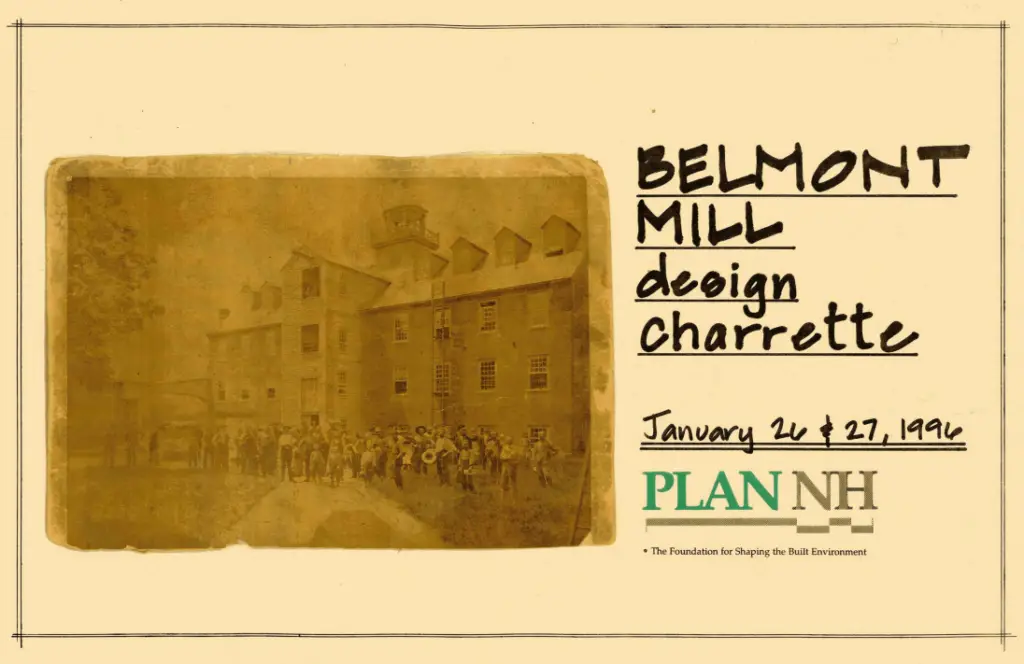
In January 1996, the town of Belmont, New Hampshire, became the testing ground for a bold idea: that meaningful community change could happen when residents and volunteer design professionals worked side by side in an intensive, collaborative planning process. That experiment — the first Plan NH Community Design Charrette — not only helped save the historic Belmont Mill, but also launched a model that would go on to shape community planning efforts across New Hampshire for decades.
At the time, the Belmont Mill, originally built in 1833, had been severely damaged by a fire in 1992 and faced possible demolition. The building was both a physical and emotional landmark for the community, symbolizing Belmont’s industrial roots and village identity. Rather than accept its loss, residents and town leaders invited Plan NH to help explore alternatives. With the support of a high-caliber, all-volunteer design team — including Jeff Taylor, Chris and Lori Williams, Jim Somes, and many others — the first Plan NH Charrette was born: a fast-paced, highly participatory design workshop that emphasized listening, visual problem-solving, and community consensus.
Listening First: Community Voices Shape the Vision
A defining feature of the Belmont charrette — and what would become the Plan NH charrette program — was its emphasis on community input before design solutions. In her analysis of early Plan NH charrettes, Julia Mistretta notes a consistent process: assessing existing conditions, holding public listening sessions, and identifying local assets before recommendations were developed. This approach, maintained to this day, helps ensure that proposed recommendations reflect what residents actually want and need, not just what professionals deem the “best” option.
In Belmont, those conversations revealed strong public interest in:
- Preserving the mill as a historic and cultural anchor
- Finding practical community uses for the building
- Strengthening the surrounding village center
These priorities guided the volunteer design team as they developed conceptual reuse plans showing how the mill could be rehabilitated and adapted rather than removed.
Turning Design into Action
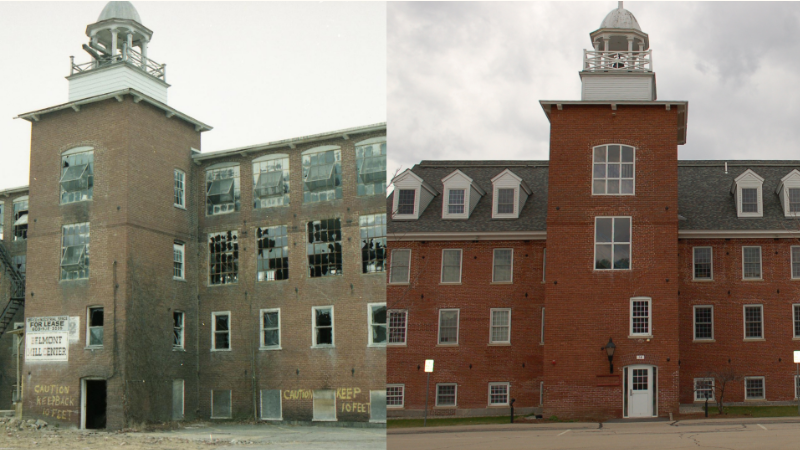
The Belmont charrette did not stop at ideas. One of the distinguishing characteristics of the Plan NH charrette program is its focus on implementation recommendations, not just conceptual design. Mistretta’s analysis highlights that charrette reports consistently include suggested next steps, potential partners, and strategies for securing resources — giving communities tools to move forward after the event concludes.
Following the Belmont charrette:
- The town pursued funding to stabilize and restore the mill.
- Federal and local resources were secured for rehabilitation.
- By 1998, the building was restored and rededicated, an achievement celebrated locally as the “Miracle on Mill Street.”
Instead of becoming rubble, the mill became a renewed civic asset, housing community services and reinforcing the village center as a focal point of town life.
Belmont’s Role in Shaping the Charrette Model
In hindsight, Belmont was not just a successful project — it became the template for how Plan NH would work with communities statewide. Mistretta identifies a key shift over time: while early charrettes like Belmont often focused on a single critical building, later charrettes expanded to include entire downtowns, corridors, or village districts. Belmont’s success helped demonstrate that focused, building-centered projects could catalyze broader community revitalization.
Her report also notes that Belmont is among a small group of New Hampshire communities to host more than one Plan NH charrette, with a second charrette held in 2010 that expanded attention from the mill itself to the surrounding village context and long-term development patterns. By that time, the mill already housed multiple community-serving uses, including education, senior services, and nonprofit programming — many of which aligned with early reuse recommendations.
A Lasting Legacy
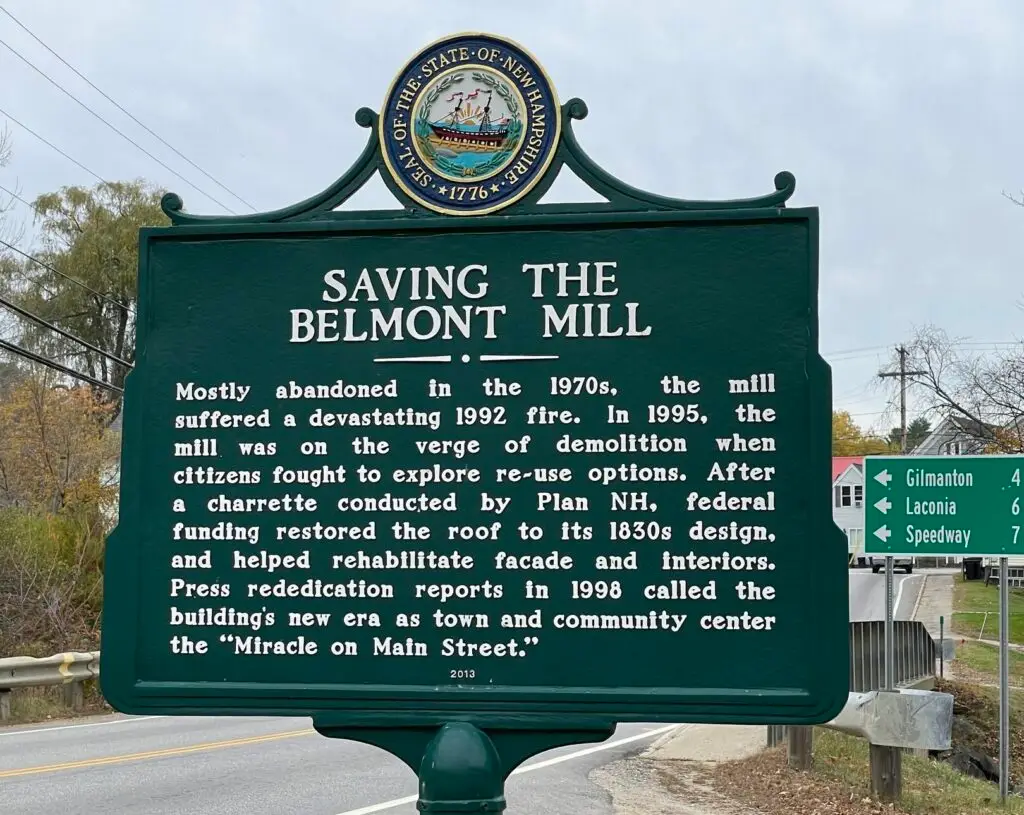
Today, the Belmont Mill stands as a physical reminder of what can happen when communities choose participation over polarization, and possibility over loss. Just as importantly, Belmont’s 1996 charrette helped launch a program that continues to empower towns and cities to shape their own futures through inclusive, design-driven dialogue.
What began as a last-ditch effort to save a single building became the foundation of a statewide approach to community planning — proving that when people are invited into the design process, they don’t just imagine change; they help make it happen.
Sources
Mistretta, Julia. Changed Communities, Shared Patterns: Plan New Hampshire Community Design Charrette Analysis. University of New Hampshire, December 2025.
Plan NH Belmont Charrette Report (1996), available here and on Plan NH’s online library.
Town of Belmont, Be lmont Mill Project: https://belmontnh.gov/community-projects/