
Celebrating 30 Years of Charrettes and A Semester at Plan NH
By Taylor Barry
This semester, I had the pleasure of interning with Plan NH. My internship was coordinated through the UNH Sustainability Institute and the College for Social Innovation’s Semester for Impact (SFI) program. The goal of this program is to foster social change and experiential learning while launching a purpose-driven career, especially through a special project.
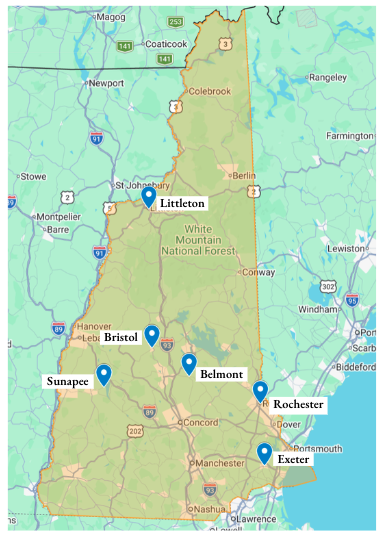
During the Fall 2025 semester, Plan NH hosted its first SFI intern, Julia Mistretta. Julia’s special project examined the commonalities among six charrettes. My special project expanded upon Julia’s, looking at nine more charrettes. I analyzed the implementation of charrette recommendations, using existing reports and Google Earth satellite images. Additionally, I conducted 28 interviews with municipal officials and charrette volunteers. Although each interview was tailored to specific charrettes, three common themes arose:
Community Engagement
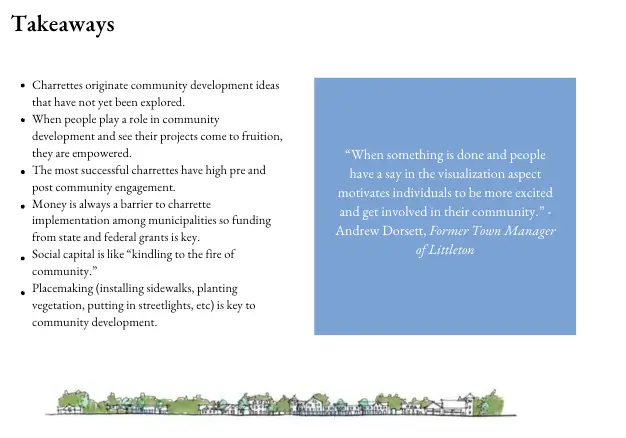
The most successful charrettes have high pre- and post-charrette community engagement. High pre-engagement is associated with controversial topics, the existence of former charrettes, and successful recruitment. High post-engagement is associated with citizen participation in committees and planning efforts. Sunapee is a great example of a town with high community engagement. The 2007 Charrette, with its restoration of the Livery Building, was so successful that the 2024 Charrette was standing room only! Following the Charrette, the Forward Sunapee Steering Committee was formed. Composed of ten residents, each committee focuses on executing one of six key areas outlined by the 2024 Charrette. These committees expanded the capacity of the municipal government, conducting in-depth analyses for projects and policies.
Money Matters
Money is a barrier to charrette implementation. This is especially true in New Hampshire where towns have limited revenue. To educate municipalities about funding options, Plan NH should continue to provide a list of resources on the final pages of its charrette reports. Additionally, as stated by Karen Prescott, the former Economic Development Director of Rochester, “The future of economic development is public-private partnerships.” For example, the 2019 Littleton Charrette focused upon the Ammonoosuc Rail Trail. After the trail was expanded several miles into Littleton, the previously vacated Hitchner Property was redeveloped into apartments called the “Rail Trail Village.” This exemplifies how public investment can serve as the impetus of economic development.
Relationships = Trust
In New Hampshire, some folks have the tendency to attach themselves to the mythic “live free or die” motto. They don’t want to see their municipalities changed too much. This poses a major challenge to charrette volunteers, who are considered outside professionals. Andrew Dorsett, the former Town Manager of Littleton, stated that the key to overcoming polarization is to “hold as many community meetings as possible. Additionally, individually meeting with groups helps establish relationships with them.” Direct relationships with residents allows municipal officials to better incorporate their views.
Recommendations
Interviews provided insight into the charrette process and proposed areas of improvement. Interviewees recommended that communities be provided with a checklist of tasks to complete prior to the arrival of the Plan NH team. Including items like advertising and accommodations, completion of the checklist would prepare the municipality for the charrette ahead. During the charrette itself, interviewees recommended that the accessibility of the public input session be expanded. Suggestions included distributing an online survey and conducting interviews with direct stakeholders. These recommendations have been implemented in the years since the interviewees’ participation, which displays how Plan NH is continuing to grow and improve.
Interviewees had suggestions for improving the implementation of the recommendations stemming from a charrette. As per volunteer Rip Patten, “After a charrette, there is a lot of momentum. Staying involved in those communities after the charrette is conducted is important to pursue and continue to conduct development.” One effective way to continue development is to engage with UNH Cooperative Extension or the Regional Planning Commissions (RPCs). As current partners of Plan NH, continued collaboration with these organizations would expand Plan NH’s resources and reach. Another positive follow-up tactic would be to explore aweb-based approach. According to volunteer Kyle Barker, “Nobody needs another book to put on the shelf. In too many charrettes, this is what is happening. A more digitized, hands-on approach could be a good solution.” To accomplish this, volunteer Jamie Simchik suggested using resources such as ArcGis and StoryMaps. Other opportunities for improvement include expanding the timeline of the charrette to two-weeks and opening up the application process to private organizations/ non-profits.
Through these interviews, I developed an understanding of the three core themes of the charrette program. Additionally, I learned about ways to improve its pre and post-engagement processes. Most importantly, I recognized the willingness of others to help young professionals advance in their career. Throughout the entire interview process, I was met with enthusiasm, encouragement, and respect. I am incredibly thankful to Plan NH, the organization’s amazing volunteers, and the organization’s partners for their help in compiling my special project this semester.