

“Changed Communities, Shared Patterns” – Charrette Analysis Report by UNH Student and Plan NH Intern Julia Mistretta
What We’re Learning from 30 Years of Charrettes
A 30-Year Look at Charrette Outcomes
As Plan New Hampshire approaches the milestone of 30 Years of Community Design Charrettes, a new report by Julia Mistretta, a UNH student majoring in Community and Environmental Planning and Sustainability, takes a closer look at what happens after the charrette ends — and what long-term patterns emerge across communities. The report, “Changed Communities, Shared Patterns,” analyzes six early Plan NH charrettes conducted between 1996 and 2004 in Belmont, Franklin, Farmington, Newport, Hopkinton, and Jackson, comparing original recommendations with what has been implemented over time.
Consistent Priorities and Evolving Scope
Across these communities, the study found strong consistency in both community priorities and professional recommendations. Common goals included:
- revitalizing downtowns,
- improving walkability and streetscapes,
- creating or enhancing greenspaces,
- supporting community centers,
- providing affordable and senior housing, and
- addressing parking and traffic safety.
While some early charrettes focused on a single building — such as the Belmont Mill or Newport’s Eagle Block — later efforts addressed broader districts and village centers, reflecting a shift toward more comprehensive, place-based planning.
Examples of Successful Implementation
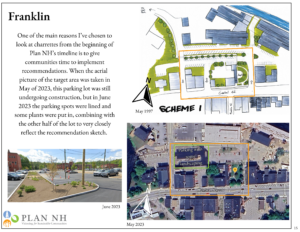
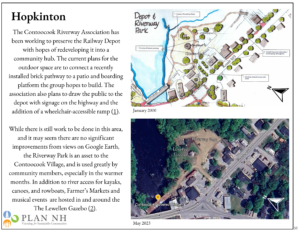
Importantly, many communities were able to implement significant elements of their charrette visions. Belmont restored and reused the historic mill as a multi-use community resource. Franklin created new greenspace and reconfigured parking downtown. Newport restored the Eagle Block, now home to Salt Hill Pub, helping anchor downtown as a destination. Hopkinton advanced riverfront access and recreational space, and Jackson has made investments in town facilities, including relocating and upgrading its historic town hall and approving construction of a new fire station.
Challenges to Implementation
At the same time, the report highlights that some recommendations — particularly major road realignments, gateway entrances, and large-scale housing developments — are more difficult to implement due to cost, land ownership, and regulatory complexity. These findings reinforce an important truth: meaningful community change takes time, and even when not all ideas move forward, charrettes often set the direction for future plans, investments, and partnerships.
Affirming the Value of Charrettes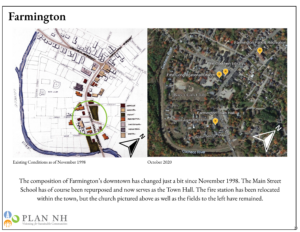
Overall, the analysis affirms that Plan NH’s charrette process has lasting value. By bringing residents, local leaders, and professionals together around shared goals, communities are better positioned to make informed, people-centered decisions that enhance quality of life. As Plan NH looks to the future, this report provides both validation of what works and insight into how the Community Design Charrette Program can continue evolving to meet changing community needs across New Hampshire.
View Julia’s full report here.
– Julia Mistretta is a junior at the University of New Hampshire studying Community and Environmental Planning and Sustainability. She interned with Plan New Hampshire in the fall of 2025 through College for Social Innovation’s Semester for Impact (SFI) program. –